Thursday, October 17, 2013
Our Dinosaur Museum Adventures!
Some Fun Facts: This museum was built in 1976 to display the collection of Dr. James A. Jensen and his crews. Over many years, Dr. Jensen has collected fossils and dinosaur bones from Utah, Colorado, Wyoming, and Montana. Many of the fossil were kept in unprepared molds and housed under the BYU Cougar Stadium until they found a home in the museum. The museum has
many fossils from the Jurassic Period (210-140 million years ago) and is one of the
top five collections from this period in the world. See this link to learn more about the museum: BYU Museum of Paleontology
We learned that a Dinosaur Hunter is called a Paleontologist*. He/she sometimes wears a hard hat, jacket, and works with tools at his/her job.
We also saw a simple pictorial definition of a dinosaur and plant fossil*: a dead dinosaur and an old tree had fallen into mud. Mud covered the dino and tree. Layers formed over the bones over the years and then wind and water erode the earth and the dino and plant are uncovered and found again as fossils.
We learned and then guessed what a dinosaur may have eaten according to the type of teeth it has. Sharp teeth are for ripping meat and are called Carnivores. Flat, wide teeth are for grinding and chewing plants and are called Herbivores.
We saw dinosaurs that swam in the sea, walked on land, and flew in the sky. Come and see some of what we saw!


We learned that a Dinosaur Hunter is called a Paleontologist*. He/she sometimes wears a hard hat, jacket, and works with tools at his/her job.
We also saw a simple pictorial definition of a dinosaur and plant fossil*: a dead dinosaur and an old tree had fallen into mud. Mud covered the dino and tree. Layers formed over the bones over the years and then wind and water erode the earth and the dino and plant are uncovered and found again as fossils.
We learned and then guessed what a dinosaur may have eaten according to the type of teeth it has. Sharp teeth are for ripping meat and are called Carnivores. Flat, wide teeth are for grinding and chewing plants and are called Herbivores.
We saw dinosaurs that swam in the sea, walked on land, and flew in the sky. Come and see some of what we saw!


Leaves, shells, trilobytes (cockroach looking animal), and other small fossils.


Example of a dinosaur fossil
A favorite mural of various dinosaurs as they may have lived and roamed.

The children are all sitting on a replica of an Dinosaur thigh (Apatosaurus femur) bone.
We have our dinosaur faces on.


Some dinosaur skeletons are quite small (like the one in the box) and are overshadowed by sharped toothed larger dinosaurs!

We have our dinosaur faces on.


Some dinosaur skeletons are quite small (like the one in the box) and are overshadowed by sharped toothed larger dinosaurs!
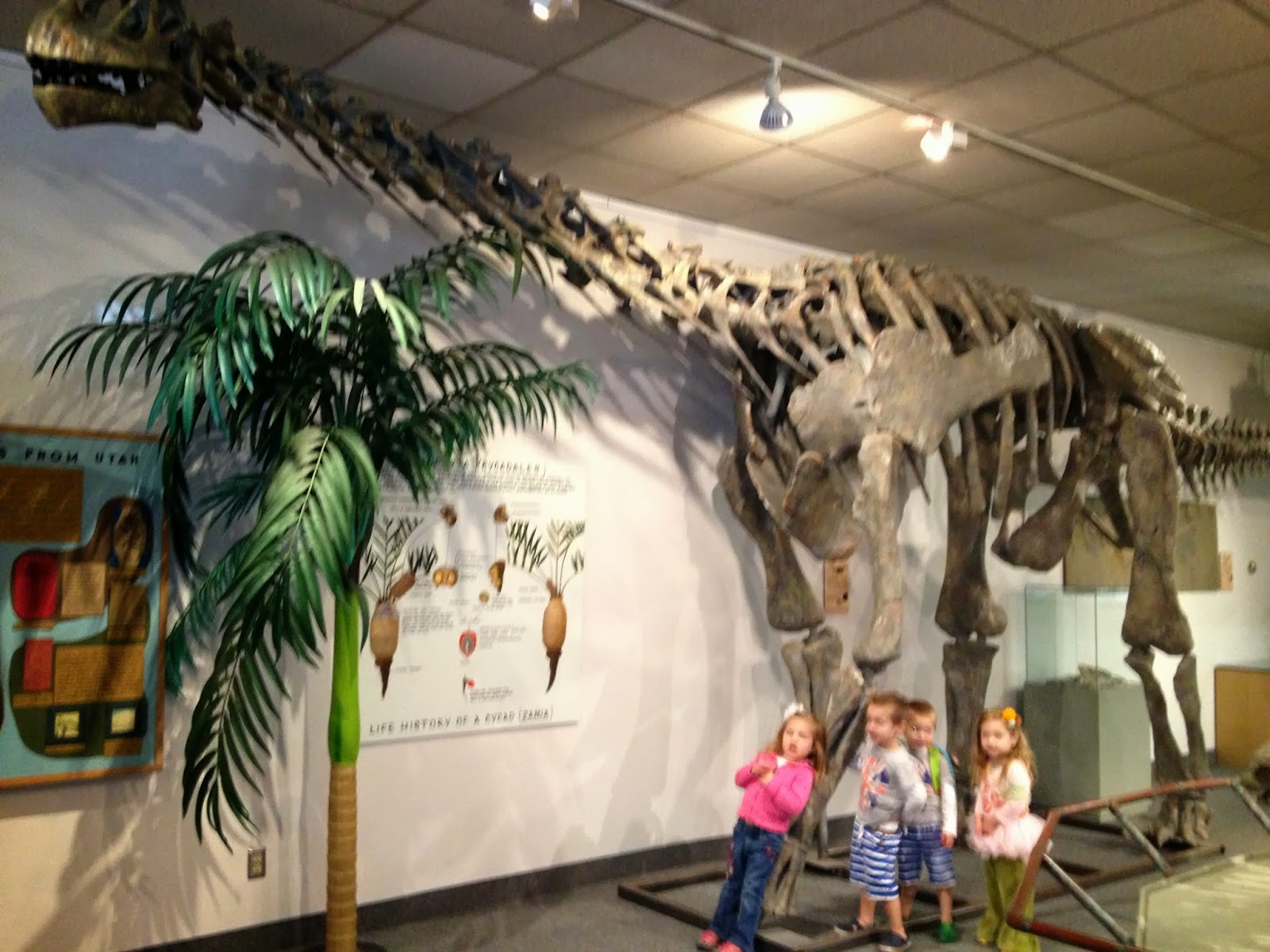
Our legs look small compared to this dinosaur


Armor Plates protected some dinosaurs, called scutes.
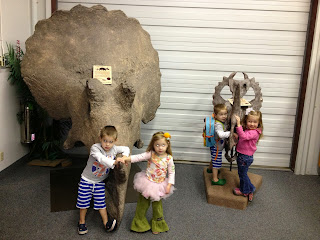


This Triceratops "Three horned face"was a flat toothed (plant eater, herbivore) with armour that may have helped defend it against a T-Rex.


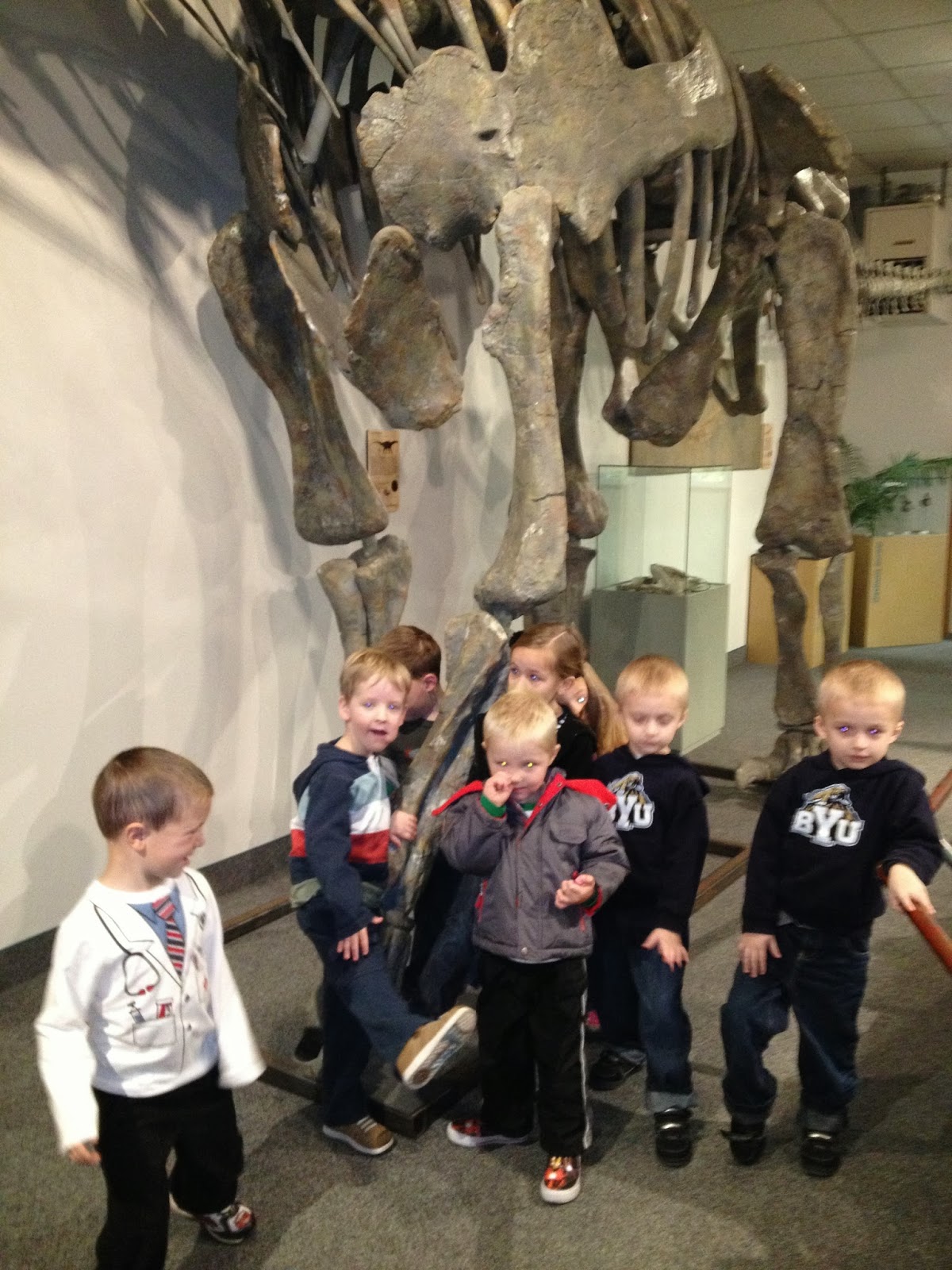

Armor Plates protected some dinosaurs, called scutes.


This Triceratops "Three horned face"was a flat toothed (plant eater, herbivore) with armour that may have helped defend it against a T-Rex.


Some dinosaur flew or had wings.


Our feet are small next to these Dinosaur footprints.


There were many places to touch and feel.
This is a petrified turtle shell.
We went to the restroom, washed our hands, and
enjoyed a snack back at school
Paleontology:Paleontology is the study of the fossil forms of all life, animals and plants.
Paleontologist: "Dinosaur Hunter;" A person who studies about fossils and the life of animals and plants as left by their bones.
Fossil: Plants or animals that become stuck in the mud, die, are covered with earth, uncovered years later and found. "Fossils are the naturally preserved remains or traces of ancient life that lived in the geological past.
Carnivore: Sharp toothed "meat eaters." Example would be a Tyrannosaurus Rex
Herbivore: Flat or ridged toothed "plant eaters" that grind and crush the foods they eat. Example from the museum the Great Ground Sloth.
Omnivore: An animal that eats both plants and animals (sharp and flat teeth).
Special Thanks to Mrs. DeGraff, Mrs. Scoville, Miss Nikki, and Mr. and Mrs. Stowe for driving and accompany us on this fun day and to Dade for fun snacks: cheese crackers, fruit leather, fruit snacks, and BONE candies!


Back at school, we had a "run around"recess outside and then worked on cutting out our and gluing our D the Dinosaur.

Dade said, "I did it! I cut it out all by myself!"


Tuesday, October 15, 2013
D is for Dancing Dinosaurs
Toys: Dinosaurs, Dinosaur puzzles, Dolls, Doll Clothes, Dominoes, and Play Doh.


Snacks: Cheez-its, Craisins, Cheese Stick Circles, Teddy Grahams, and Fruit Snacks.
I
was impressed at Snack Time that more and more students are being
willing to try a bite of something new. Eva tried Craisins after
resisting and then asked for more. She learned she likes them.We listened about D the Dinosaur dancing disco in her father's diner until she is called to dinner. "D d d" is the sound her foot makes dancing. Students tap heel on the ground and say, "D(ah) d(ah), d(ah)."
I am excited that the children now know the long and short A sounds, B, C, and D sounds which will help them to sound out simple words like: D-a-d, b-a-d, c-a-b, a-d-d, etc.

Dinosaur Faces!
Recess Outside: Digging for "fossils" in the sandbox, exploring different geological terrain with the airplane and ride on vehicles.
Eleanor: 3 Dinosaurs; Ankylosaurus, Brontosaurus (Apatosaurus), and Allosaurus

Brody: Dinoco Car

Ethan: Tyrannosaurus Dinosaur
Eva: Pink Dog named "Ruffy"

Kayson: Black Dog named "Cute."
William: Tyrannosaurus Dinosaur
D the Dinosaur Activity Page: Today we began coloring the big letter D. Thursday, we will cut* her out and put "dots" on her and glue her onto a favorite color page. (*An important skill at this age is using scissors. This helps the students practice fine motor skills. Several students seemed to not know how to hold and cut with scissors, please practice at home.)


Dinosaur Books:
Ten Little Dinosaurs by Pattie Schnetzler, Ill. by Jim Harris (An
Eyeball Animation Book)
My Tall Book of Dinosaurs (Preschool Press)
My Tall Book of Dinosaurs (Preschool Press)
Encylopedia Prehistorica Dinosaurs by Robert Sabuda and Matthew
Reinhart (Pop-up Book)How Do Dinosaurs Eat Their Food? by Jane Yolen and Mark Teague
How Do Dinosaurs Say Good Night? By Jane Yolen and Mark Teague
Time Flies by Eric Rohmann (Caldecott Honor Book) Illustrated (no words)
Happy Holidaysaurus! by Bernard Most
Dinosaurs, Learn About Books by Brimax, 4-7 years
A Book to Begin on Dinosaurs by Eunice Holsaert and Robert Gartland
Dinosaurs; Over 100 Questions and Answers to Things You Want to Know by Dan Abnett and Nik Vincent
Dinosaurs Are Different by Aliki, Let's-Read-And-Find-Out-Science (Harper Collins)
Dinosaurs Magazine; Made for Kids! (World Color Press) Sept./Oct. 1997.
Dinosaur Dream by Dennis Nolan
James Gurney's Dinotopia Pop-up Book (Turner Publishing)
Dinotopia by James Gurney
Dinotopia; The World Beneath by James Gurney
Dinosaur Time by Peggy Parish and Arnold Lobel (An I Can Read Book)*
The Berenstain Bears and the Missing Dinosaur Bone by Stan and Jan Berenstain
Dinosailors by Deb Lund and Howard Fine
Whatever Happened to the Dinosaurs? By Bernhard Most
How Do Dinosaurs Say Good Night? By Jane Yolen and Mark Teague
Time Flies by Eric Rohmann (Caldecott Honor Book) Illustrated (no words)
Happy Holidaysaurus! by Bernard Most
Dinosaurs, Learn About Books by Brimax, 4-7 years
A Book to Begin on Dinosaurs by Eunice Holsaert and Robert Gartland
Dinosaurs; Over 100 Questions and Answers to Things You Want to Know by Dan Abnett and Nik Vincent
Dinosaurs Are Different by Aliki, Let's-Read-And-Find-Out-Science (Harper Collins)
Dinosaurs Magazine; Made for Kids! (World Color Press) Sept./Oct. 1997.
Dinosaur Dream by Dennis Nolan
James Gurney's Dinotopia Pop-up Book (Turner Publishing)
Dinotopia by James Gurney
Dinotopia; The World Beneath by James Gurney
Dinosaur Time by Peggy Parish and Arnold Lobel (An I Can Read Book)*
The Berenstain Bears and the Missing Dinosaur Bone by Stan and Jan Berenstain
Dinosailors by Deb Lund and Howard Fine
Whatever Happened to the Dinosaurs? By Bernhard Most
Monday, October 7, 2013
Cycle of a Butterfly
Cycle of a Butterfly
 Daily Question: Cc Do you know what
a chrysalis is? Before it becomes a
butterfly, a caterpillar goes through a growth stage during which it is called
a "chrysalis." On the surface it may not look like much is happening,
but the delicate chrysalis process changes the fuzzy caterpillar into a
beautiful butterfly with wings of intricate designs and intense colors.
Daily Question: Cc Do you know what
a chrysalis is? Before it becomes a
butterfly, a caterpillar goes through a growth stage during which it is called
a "chrysalis." On the surface it may not look like much is happening,
but the delicate chrysalis process changes the fuzzy caterpillar into a
beautiful butterfly with wings of intricate designs and intense colors.
Cc Do you know what
a cocoon is?
Answer comes from the below website "Butterflies hatch from a chrysalis, a life stage made of a hardened
protein. A cocoon is spun from silk and surrounds the pupa of many
moths.*"
Neat link: The Children's Butterfly Site
We study an old Chrysalis:Neat link: The Children's Butterfly Site


Snack Time: Strawberry slices, club crackers, grapes, and graham crackers
We had fun listening to I Love
Bugs while we ate our snack time. In the end we went on a "Leaf Hunt" for our
Caterpillar Activity.

We read some great books about the Cycle of a Butterfly and then heard a story about C the Caterpillar who cuts leave and chews them to gain strength to build a cocoon (chrysalis) and become a butterfly. The children make a cutting action with their fingers and say "cah, cah, cah."


Eva shows our Very Hungry Caterpillar Game (from the Book by Eric Carle)
Circle Time:
C Show N' Teach
Dade's yellow paper,
William's Castle Pop-up Book,
Eleanor's Purple Butterfly--"I named her 'Purple'--She started out a caterpillar wrapped in a chrysalis!"
William's Castle Pop-up Book,
Eleanor's Purple Butterfly--"I named her 'Purple'--She started out a caterpillar wrapped in a chrysalis!"


Ethan & Kayson's Butterflies and nets.
 Brody: Dinosaur
Recess and Leaf Hunt: We spied a spider, big ants on leaves, and many different types of leaves on our Bug/Leaf Hunt.
Meet brothers Theo and Oscar, new students on Tuesdays.


We're going on a Bug (and leaf) Hunt!


Spying a spider.

C the Caterpillar's Leaf Rubbing Activity:

So many leaves to choose from!


Leaf Rubbings--Put leaves under the paper, use flat edge of the crayon, and rub!
Butterfly Books:
Caterpillar Spring, Butterfly Summer by Susan Hood, Claudine Gevry, & Mara Van Fleet
The Very Hungry Caterpillar by Eric Carle
I Love Bugs by Philemon Sturges (audio book)
In the Tall, Tall Grass by Denise Fleming
A Child's First Library of Learning, Insect World (Time Life)
Other Books on Butterflies/Moths:
Butterfly Express; A Book About Life Cycles (Child's Word. Magic Castle Readers)
The Bug Book by Dr. Hugh Danks
Know-It-Alls: Butterflies by Darlene Freeman and Mike Maydak
How to Hide a Butterfly by Ruth Heller
I Wonder Where Butterflies Go In Winter, and Other Neat Facts About Insects (Golden Book)
Butterfly & Moth (Eyewitness Books) by Paul Whalley
Percival the Plain Little Caterpillar by Helen Brawley (Bright pictures and foil cut outs).
Butterfly Express; A Book About Life Cycles (Child's Word. Magic Castle Readers)
The Bug Book by Dr. Hugh Danks
Know-It-Alls: Butterflies by Darlene Freeman and Mike Maydak
How to Hide a Butterfly by Ruth Heller
I Wonder Where Butterflies Go In Winter, and Other Neat Facts About Insects (Golden Book)
Butterfly & Moth (Eyewitness Books) by Paul Whalley
Percival the Plain Little Caterpillar by Helen Brawley (Bright pictures and foil cut outs).
Songs:
Janeen Brady's song,"See Me Run."

Subscribe to:
Posts (Atom)